


9 Positive Message Shirts for Siblings They'll Love
Last Updated: November 10, 2026
Quick Summary
The best matching sibling shirts fall into three message themes: affection, encouragement, and belonging, and mixing themes across a set usually reads better than forcing every shirt into the same phrase. Choose age-appropriate wording for each child, since the older sibling's shirt should feel like a promotion, not a demotion.
- Funny sibling shirts work when the joke lands on shared chaos, never on the child.
- Keep toddler phrases to three or four words using a concrete noun the child knows.
- For three or more kids, use a shared motif with individual wording so the set scales.
- Measure every sibling on the same day and order the full set together for color consistency.
- Keep personalization on the front small and readable so long names don't wrap awkwardly.
Table of Contents
- Why Positive Message Sibling Shirts Beat Generic Matching Sets
- Matching Sibling Shirts by Theme: Affection, Encouragement, and Belonging
- Funny Sibling Shirts That Stay Positive
- Big Brother, Little Brother, Big Sister, Little Sister: Age-Appropriate Wording
- Matching Shirts for Three Siblings and Larger Families
- Personalized Sibling Shirts: Names, Roles, and Custom Combinations
- Sizing, Fabric, and Buying Guidance for Sibling Shirt Sets
- Build Your Sibling Shirt Set With The Tee Shop
- Frequently Asked Questions
Why Positive Message Sibling Shirts Beat Generic Matching Sets
Most matching sets sell a photo op. Positive message sibling shirts sell a relationship, a difference that matters more than parents expect when comparing two racks of nearly identical tees.
A generic matching set coordinates color and cut; a message-driven set coordinates values.
For the deeper argument, our guide to positive message shirts for kids explains why wording beats graphics.
Matching Sibling Shirts by Theme: Affection, Encouragement, and Belonging
The best matching sibling shirts fall into three message themes: affection, encouragement, and belonging. Each does a different job for a different age gap, and mixing themes across a set usually reads better than forcing every shirt into the same phrase.
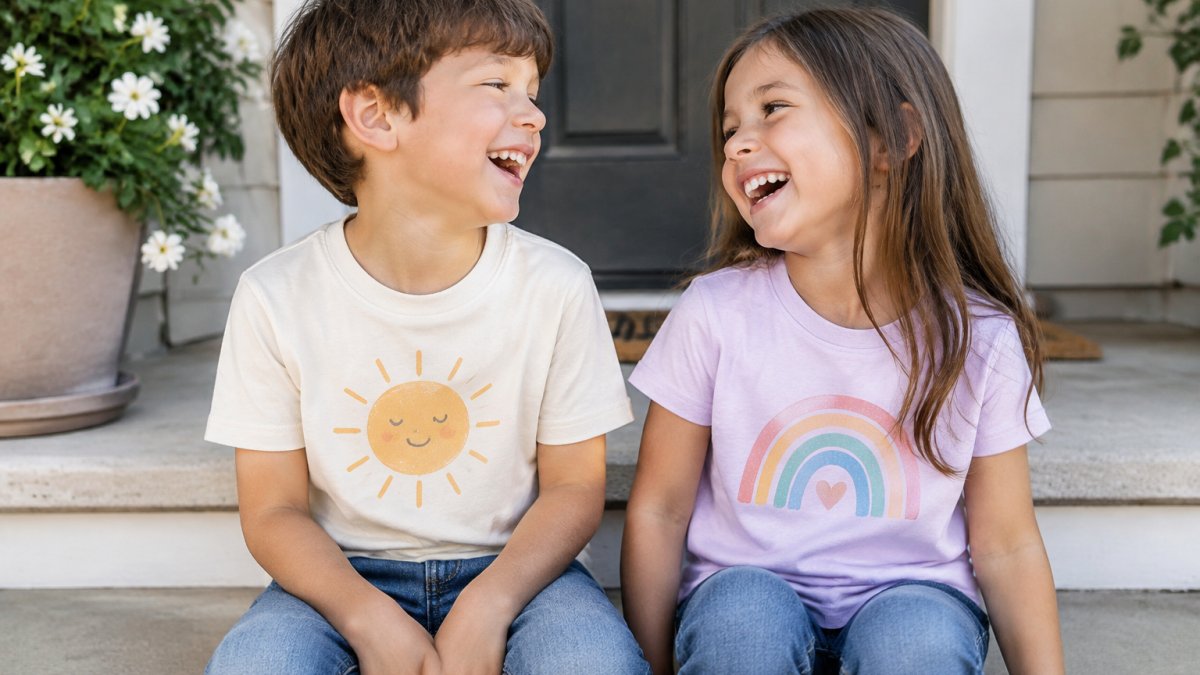
Affection and Kindness Messages
Affection messages work best for siblings close in age or newly paired, because the wording is simple enough for a toddler to repeat: "Kind to My Brother," "Big Sister, Big Heart," or a paired "I've Got You" and "You've Got Me." Avoid phrases the older child finds babyish, if the big kid won't wear it, the set dies.
Encouragement and Confidence Messages
Encouragement themes suit a wide age gap, where the older sibling naturally plays coach. Paired designs like "Watch Me Grow" beside "Watch Over You," or "Brave Little Brother" beside "Braver Big Sister," give the older child a role instead of a costume. The older sibling's shirt should sound like a job title, not a compliment.
Funny Sibling Shirts That Stay Positive
Funny sibling shirts work when the joke lands on the situation, never on the child.
Avoid anything that ranks siblings against each other. A shirt implying one child is the favorite, the smart one, or the accident gets worn once and buried in a drawer. Humor should punch at bedtime, car rides, and shared snacks, not at a person.
Big Brother, Little Brother, Big Sister, Little Sister: Age-Appropriate Wording
Age-appropriate wording separates a set worn weekly from one worn for a single photo. The younger child's shirt should be readable by the younger child, and the older child's shirt should feel like a promotion, not a demotion.
The right message changes with each child's age, not just the age gap. Here's how we'd choose wording across the four most common situations.
Toddlers and preschoolers (roughly 2 to 5)
At this age the child isn't reading the shirt but is absorbing the label. Keep the phrase to three or four words, use a concrete noun the child knows (brother, sister, friend, helper), and avoid irony.
Watch out: a phrase that depends on a joke or a pop-culture reference will read as nonsense to a four-year-old and as dated to the parent by next season.
Early elementary (roughly 6 to 9)
This is the sweet spot for role language, because the child can read the shirt and still enjoys being named. Pair a role with a trait rather than a rank: "Big Brother, Brave and Kind," "Little Sister, Quick to Laugh," "Big Sister, Good Listener." Avoid "boss" and "baby" as standalone labels, both get used as weapons on the playground by second grade.
Older children and tweens (roughly 10 and up)
Older kids will wear a matching shirt for a family event, vacation, or reunion, but not for school. The wording must be genuinely funny or genuinely warm, with no cutesy diminutives. Reciprocal phrasing beats role phrasing: "I've Got Your Back" paired with "I Know You've Got Mine," or "Team [Family Name]" with each child's first name underneath.
New siblings and babies
A newborn can't read a message, so the parents do. Baby announcement and sibling reveal shirts usually put the wording on the older child's shirt, with the new sibling in a plain companion color or a simple "New to the Crew" print. Name the promotion, not the displacement: "Big Brother, Officially" or "Promoted to Big Sister" lands better than framing the baby as a replacement for attention.
Large age gaps (five or more years)
When one sibling is in middle school and the other in diapers, matched phrases read as a costume on the older child. The fix is a shared motif with different registers: same color and print style, but the older child's shirt carries a coach or protector message ("Watch Me Grow" beside "Watch Over You") while the younger child's carries a simple, readable phrase.
Brother-and-sister combinations
Skip ranking language and use reciprocal phrasing: "My Brother's Keeper" and "My Sister's Cheerleader," or "Brother Bear" and "Sister Bear" with matching artwork. Reciprocal messages avoid implying one role outranks the other, which matters more in mixed-gender pairs where siblings already negotiate fairness constantly.
A quick decision framework
Before you buy, answer three questions for each child: Can this child read the phrase themselves? Would this child repeat it out loud without embarrassment? Does it describe a behavior the child can actually perform this week? If any answer is no, adjust the wording before adding personalization.
Matching Shirts for Three Siblings and Larger Families
Matching shirts for three siblings require a different structure than pairs, because three-way designs break the moment one child outgrows the theme or the family adds a fourth. The fix is a shared motif with individual wording: same color, same print style, and phrases that only make sense together as a set.
Here are the set structures that hold up, plus how to handle the family shapes generic listings ignore.
Set structures that work for three or more
The role ladder. "The Oldest," "The Middle," "The Baby" in the same font and color. Simple, readable, and easy to extend if a fourth child arrives.
The numbered crew. "Trouble One," "Trouble Two," "Trouble Three," or "Crew Member 1" through "Crew Member 3." Numbers scale cleanly to four, five, or six kids, and the humor lands on the group rather than any one child. This is the easiest structure to extend later because the design logic doesn't change when you add a shirt.
The shared phrase with names underneath. One family phrase ("Team [Family Name]," "The [Family Name] Bunch," "Raised on Love") printed identically on every shirt, with each child's first name or birth order in smaller type below.
The reciprocal pair plus one. For three siblings where two are close in age and one is much younger or older, pair the close two with reciprocal messages ("I've Got You" and "You've Got Me") and give the third a companion shirt in the same color with a standalone positive phrase. The set still reads as coordinated in photos because color and print style match, even though the wording isn't identical.
Blended, step, and adopted family structures
Choose wording the children actually use for each other. If the kids say "my stepbrother" or use first names rather than "brother" and "sister," put those words on the shirt.
For adopted and foster families, avoid designs that lean on birth order or biological language ("born to be" phrasing, hospital-themed graphics, or "the baby of the family" when the youngest joined later).
Twins and nonbinary children
For twins, skip "older" and "younger" labels unless the family actually uses them. Use matched-but-distinct wording instead: "Twin A" and "Twin B" reads as a joke, while "Double Trouble" paired with "Trouble Times Two" reads as a set. For nonbinary children, choose role-neutral phrasing ("Big Sib," "Little Sib," "Oldest," "Youngest," or first names only).
Practical coordination for big families
Order the whole set at once and check the size chart for every child in the same sitting.
Keep a simple record of what you ordered: color name, print style, phrase, size, and child.
Watch out: ordering one size up "to grow into" usually backfires on the younger sibling, who ends up swimming in fabric while the older child's shirt fits correctly.
Personalized Sibling Shirts: Names, Roles, and Custom Combinations
Personalized sibling shirts solve the biggest weakness of matching sets: identical shirts erase individuality, and kids notice.
The combinations that hold up best are name plus role, like "Maya, Big Sister," or a matched pair whose wording only completes when the siblings stand together.
One insider tip: keep personalization on the front small and readable.
Sizing, Fabric, and Buying Guidance for Sibling Shirt Sets
Sizing and fabric decide whether a sibling shirt set survives real life. Measure each child fresh rather than ordering last season's size, and use a proper guide: our walkthrough on how to measure kids for clothing covers chest, length, and shoulder in a few minutes per child.
On fabric, soft cotton with a quality print matters more than thread count marketing. Kids with sensitive skin react to rough seams and stiff transfers, so our guide to fabrics for sensitive skin explains which materials to prioritize. For laundry, our piece on washing kids play clothes without fading or shrinking covers the wash settings that protect both.
| Buying Factor | What to Check | Why It Matters |
|---|---|---|
| Sizing | Measure chest and length per child | Prevents returns across a multi-shirt order |
| Fabric | Soft cotton, smooth seams | Comfort for sensitive skin and daily play |
| Quality print method | Survives repeated washing | |
| Wording | Age-appropriate phrase per child | Keeps older siblings willing to wear it |
| Personalization | Short names, small type | Stays readable and looks intentional |
A quick checklist before you order:
- Measure every sibling on the same day
- Confirm the phrase suits each child's age
- Check the print method and care instructions
Watch out: ordering one size up "to grow into" usually backfires on the younger sibling, who ends up swimming in fabric while the older child's shirt fits correctly. The set looks mismatched in photos even though the sizes are technically right.
Build Your Sibling Shirt Set With The Tee Shop
The Tee Shop builds sibling shirts around the message first, then wraps it in apparel that survives playtime and the washing machine. If you're weighing us against another positive-message apparel option, our guide to choosing a Lovelingo Apparel alternative lays out the comparison.
Pricing depends on the set, sizes, and personalization you choose, so check The Tee Shop website for current prices or a quote.
Building a coordinated set for two, three, or more kids takes more thought than clicking "add to cart" on identical tees, and that thought is exactly what makes the shirts get worn.
Frequently Asked Questions
What are some positive messages to put on matching sibling shirts?
Short, warm phrases work best: 'Team [Last Name],' 'Big Sister, Big Heart,' 'Little Brother, Big Joy,' 'Kindness Runs in the Family,' and 'My Sibling Is My Best Friend.' Keep wording simple enough for young readers, and pair it with a playful graphic like a heart, sun, or matching animal. If you want the message to grow with the kids, choose a phrase that works at any age rather than one tied to a baby stage.
Can siblings wear matching shirts that have different messages?
Yes, and it often works better than identical shirts. Matching sibling shirts can share the same color, fabric, and graphic while each shirt carries a role-specific line, such as 'Big Brother' and 'Little Sister.' This lets kids feel connected as a set without losing their individual identity. For families with wide age gaps, different messages also solve the problem of wording that feels too babyish for an older child.
How do you choose matching shirts for siblings of different ages?
Start with a shared design and color, then adjust the wording by age. Older kids usually prefer a phrase that reads as cool rather than cutesy, while younger ones respond to simple, cheerful lines. Check the size chart for each child separately, since a 3-year-old and a 6-year-old may need different fits even in the same style. Soft cotton and tag-free seams matter most for the youngest wearers.
Are matching sibling shirts a good gift for a new baby?
They are a popular choice for baby showers, sibling reveals, and birth announcements. A set with 'Big Brother' or 'Big Sister' paired with a newborn onesie helps an older child feel included in the new arrival. Order the older child's size first and confirm the newborn size closer to the due date, since sizing for infants varies. Add the baby's name for a personalized sibling shirt set that doubles as a photo keepsake.
